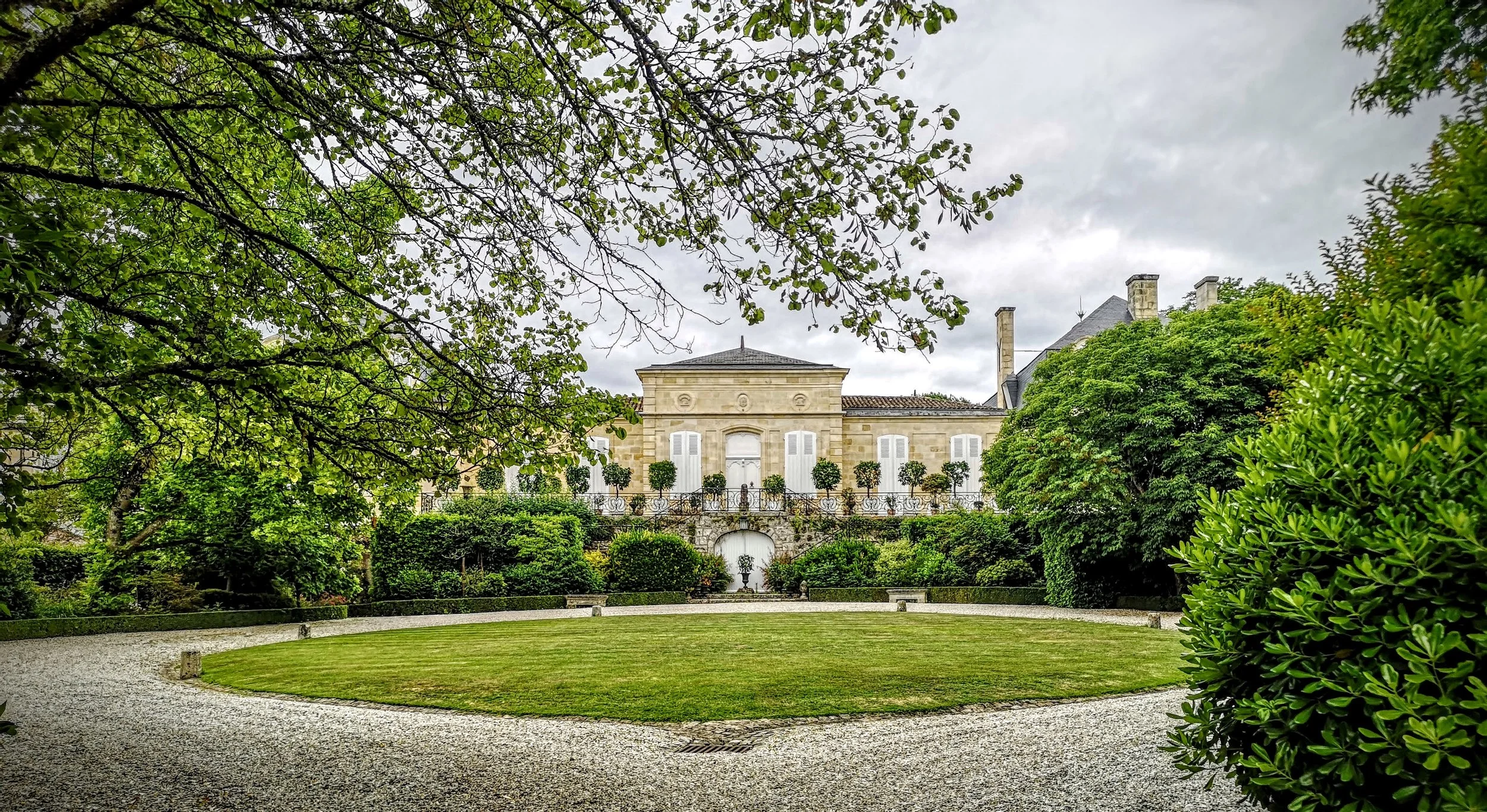
Château Léoville-Barton: The Gentleman Of The Médoc
When I started in the wine industry too many years ago to mention, the countries and regions that produced the wines that I sold always felt a very long way away indeed. But now, with winemaking creeping ever northward these days, it is not unusual to stumble upon a vineyard while I am walking the dogs amid my beloved Cotswolds hills.
But even with the chance to visit those famous, storied regions remains a special pilgrimage, journeying to places where winemaking heritage can stretch back a millenia. There the wine culture seeps in to everything around you, from the blades of grass to the very stone of the buildings. These are the great cathedrals of wine, regions where tradition has been handed from one generation to the next, techniques honed and perfected, and the product of their labour comes to define the area. And few embody that quite as much as the Médoc.
And while vines have been planted here since Roman times its modern history started when the canny Dutch drained the marshland in the 17th century, revealing its true treasure: its soil. It is these deep, free-draining gravel and limestone soils anchored by clay beds, nurtured by the Gironde’s tempering influence and shielded from the Atlantic’s worst excesses by a vast pine forests to the west that create a magic you would not guess at looking at its unassuming landscape.
But that landscape belies the truly profound wines the Médoc is capable of. This is the French concept of terroir, a myriad of almost intangiable, microscopic factors that combine to make a region special. Many of those the human factor cannot control: the soil, the wind, the sunshine, or the vagaries of a given growing season. But what we can control is the vines, the varieties we plant and where we plant them. And with its viticulture stretching back two thousand years, the Bordelais have had a lot of practise at that. This is the unique combination of vine, place and people that make the Médoc so special.
And in this country our affinity for claret that surpasses any other. Our relationship with the region is ancient, almost a thousand years of a unique cultural synergy. And in that time we have shared more than just wine; we have shared kings. Henry II married Eleanor of Aquitaine, whose son was Richard the Lion Heart, buried there where he spent most of his life when not crusading. Henry IV was crowned King of England in the City of Bordeaux.
Samuel Pepys was a fan, writing this in his diary on the the 10th of April 1663 about his first taste of Haut-Brion:
“Off to the Exchange with Sir J Cutler and Mr Grant to the Royal Oak Tavern in Lumbard Street and there drank a sort of French wine called Ho Bryan, that hath a good and most particular taste that I never met with.”
Our calamitous vote to leave the EU was perceived with an air of nochalence in Bordeaux; a few raised eyebrows and a Gallic shrug at best. Trade between us existed long before it and there was a certainty that it would continue long after. Our love for the wines means long as the vines grow in Bordeaux, we will be there to drink it.
So there was a real frisson of excitement that morning that was much more than the promise of a fine repast after a very early start and long journey. Because we were being hosted by Damien Barton-Sartorius owner of the legendary 2nd Growth Léoville-Barton, one of the jewels of the Médoc and shining star of its smallest commune St. Julien.
While it lacks the first growths of neighbouring Pauillac and Margaux, St. Julien does have a host of Deuxièmes Grands Crus Classés. Indeed 87% of the estates within the commune were awarded Cru Classé status in 1855, the highest of any comune in the Haut-Médoc, so while it lacks the gravitas of a 1er Cru it makes up for it with an obdurate consistency. It is hard to find a bad glass of St. Julien, harder still to find one from Léoville-Barton.
Famously there are three Léoville estates in St Julien and you may wonder how they relate to each other. There is a fascinating history behind it: all originally were part of the mighty Léoville estate, at the time the largest in the Médoc.
Its owner, the Marquis de Las-Cases-Beauvoir, was forced to flee during the French revolution and the estate was seized. All of it was intended to be sold but only the quarter that was to form Léoville-Barton eventually was, to Irish merchant extraordinaire Hugh Barton, whose family had been trading in the region since 1725 and already the steward of neighbouring Château Langoa-Barton.
Hugh had himself been arrested by the revolutionary forces but was fortunate enough to be released, and fortune further smiled on him with the unlooked for opportunity to buy those rarefied vineyards from his neighbour. There was a gentleman’s agreement to return the vineyards but once the threat of Madame Guillotine and the Marquis could come home, he did not have the funds to buy them back, so they stayed with the Barton family. Poyferré was later divided from Las-Cases through inheritence.
Unsurprisingly Hugh’s new vineyards came with no Château or winery: those stayed at Las-Cases. Instead they used the Château and facilities they already owned at Langoa, a situation that remains to this day. In fact the Château depicted on Léoville-Barton’s beautiful label is actually Langoa, creating a conundrum of Matrix-esque proportions: just as there is no spoon, there is no Château Léoville-Barton!
But then the soul of any great wine estate lies with the vineyards not its buildings. Léoville-Barton’s 50 hectares of vines sit atop a beautiful bank of deep Pyrenean gravels with limestone and sand sitting on a bed of clay, almost kissing the Gironde, just south of those of Las-Cases and Poyferré with Ducru-Beaucaillou beyond.
The free-draining upper-layer forces the vines to dig deep for water, while the clay bed retains it, a saving grace when the dry conditions of a hot Bordeaux summer begin to bite. The vineyards also boast some of the oldest vines in the Médoc, a legacy of Ronald Barton who was steward of the estate in the post-war period. A staunch traditionalist Ronald resisted replanting the vineyards after the neglect of the war enabling the estate to make some of the great post-war vintages, and cementing Léoville-Barton’s reputation for elegant but hugely concentrated wines.
After the conservatism of Ronald’s reign, the modern era of the estate really began when his nephew Anthony Barton took over in 1986. Anthony was born in Kildare County in Ireland but spent most of his life in Bordeaux and became one of its most iconic figureheads, a true gentleman of the Médoc.
Under him Léoville-Barton grew into its modern form, with an inimitable reputation for excellent, long-lived claret at, most importantly, fair prices. For while Anthony threw off the conservatism of his uncle’s time and embraced modernity, he remained a man of remarkable principle, out of step with many of his peers by refusing to arbitrarily increase his prices, or chase the critical approval of a single man who at the time held such a disproportionate influence over Bordeaux’s commercial success.
He eschewed the exuberance that demanded and instead honed the traditional style that followers of Léoville-Barton expected. And it was appreciated, certainly here in Britain, with the estate’s release always one of the most hotly anticipated in any given vintage, and 40% of its total production sold here. I remember my first en primeur tasting, the 2009 vintage, where steadily less orderly queues formed to taste the nascent 2nd Growth, without doubt the star of the evening.
Sadly Anthony passed in 2022 but by that time a new generation of Bartons were ready to take up the baton, with an unbroken familial line of ownership stretching back over 180 years, the oldest in the Médoc and one of only two estates to be owned by the same family at the time of the 1855 classification, the other being Mouton-Rothschild.
And meeting with Damien it was clear he is cut from the same cloth as his grandfather. He and Izarra the dog hosted us beneath the warm June sunshine on a well-appointed terrace overlooking the Château’s stunning gardens. Hearing him speak you really get a sense of his passion for the the familial legacy, the Château, the region, the vineyards and the winemaking process.
His philosophy is a simple one but one that shapes the entire approach at the venerable estate. He believes the work is done in the vineyard, echoes of the same philosophy I heard working at Felton Road in New Zealand. Their biodynamic method sets soil health above all else, because to getting that right creates a domino effect translating into rude vine health necessary to produce profound berry fruit at harvest.
I had the chance to express this to Damien and there was immediate empathy, a shared philosophy between two disparate estates half the world apart, growing different varieties on contrasting terroirs, but both with an international reputation for superlative wines. There must be something to it.
Léoville-Barton employs a permanent staff of over 50 people, a good proporation dedicated to the vineyard allowing quick reactions to shifting conditions throughout the growth cycle.
In the past vignerons were more likely to try arm-wrestle mother nature into submission, with herbicides and pesticides that seep into the soil striping it of nutrients and killing the micro-organisms that make up the vital humus that feed the vines. Once gone it needs replacing, so further chemicals in the form of fertiliser and plant food are needed, trapping you within an artificial cycle it is difficult to break free from.
I have been in such a vineyard in New Zealand. The entire block of vines were covered entirely by a white net to ‘protect’ them from the birds and insects. Passing beneath it felt like passing under a funeral shroud, and beyond was an unatural stillness. Aside from the vines there was nothing, barely a blade of grass.
There was a genuinely eerie quality to it; a sense of wrongness that pervaded it. Coming from vineyards that positvely burst with life, from the chickens that lived there semi-feral, to the spiders and earwigs that would surprise you as you snipped the berries from the vine, to the finches that circled in flocks above, and the wild Angora goats that lived on the bluffs overlooking it, it was hard to imagine anything good produced from that shrouded, lifeless place.
And of course that is the ultimate purpose, to deliver great fruit at harvest, because without it you simply cannot make great wine, no matter what tricks you might employ in the winery. Modern vignerons see themselves as partners not masters of the vineyard and seek a natural harmony with it and the land around.
But it is not complete laissez-faire, there are not ‘natural’ wines; the competent maintain a hands-on approach, prepared to give nature a nudge in the right direction if she errs too far. Even the great bastion of biodynamics Felton Road kept a bag of sulphites in reserve, just in case. Not that they ever had to use it.
This is the way modern Médoc wine is made, and these days the Médoc is very modern indeed. No region has transformed itself more over the last 20 years. Coffers swollen from a series of acclaimed vintages and a pre-eminent position in the fine wine market, and spurred on by generous tax breaks for re-investment, Bordeaux’s venerable Châteaux have revolutionised themselves.
Gone are the pre-war presses and ancient foudres, and in their place gravity-flow wineries, suspended tanks and raw earth walls. Concomittant with the slow rise in vineyard temperatures has been this rapid embrace of modernity and the region now boasts some of the most sophisticated cellar architecture in the world. That has bought a noticable paradigm shift in the style of wines made.
While they retain the puissance of before now they are plush, fruit-generous and fresh. No longer is tasting young cru classés an exercise of endurance, coming away punch-drunk from the fierce, green tannins that pucker the palate. More than once at recent en primeur tastings have I heard ‘I could drink that now’, something unthinkabe 15 years ago.
Burgundy purists might point at this as further evidence that Bordeaux wines are born of the winery rather than the vineyard, unlike the direct terroir expressions of their beloved region. But that holds less and less water; Léoville-Barton’s disparate plots of Cabernet Sauvignon, Merlot and Cabernet Franc are clustered together over a small area, rare in the Médoc, and each vinified seperately before each being carefully tasted and selected during the l’assemblage.
Each are a product of their own micro-terroir and one wonders what they might become were they bottled as such. But unlike a Burgundy domaine that may produce dozens of different wines from varied vineyards, Médoc’s Châteaux will only make two or at most three, any surplus sold to selected négociants to bottle.
Here the art of the blend is king, and it is an art to be admired, their wines testament to traditions honed over generations. Each captures the natural magic and nuance of a growing season, like a new child. Some are errant, some ebullient, others reticent and shy, but all are precious, and all are an indelible record of the year.
No matter what the critical consensus is of a vintage, when you live through they are all are memorable (even if there are some you would rather forget). They become disparate expressions of the viticulture and the winemaker’s art, each unique and characterful. I remember Marc Perrin of Beaucastel once telling me there are no bad vintages, just different expressions of the terroir and the winemakers art. I sure other winemakers will agree, the rest of us perhaps a little less convinced.
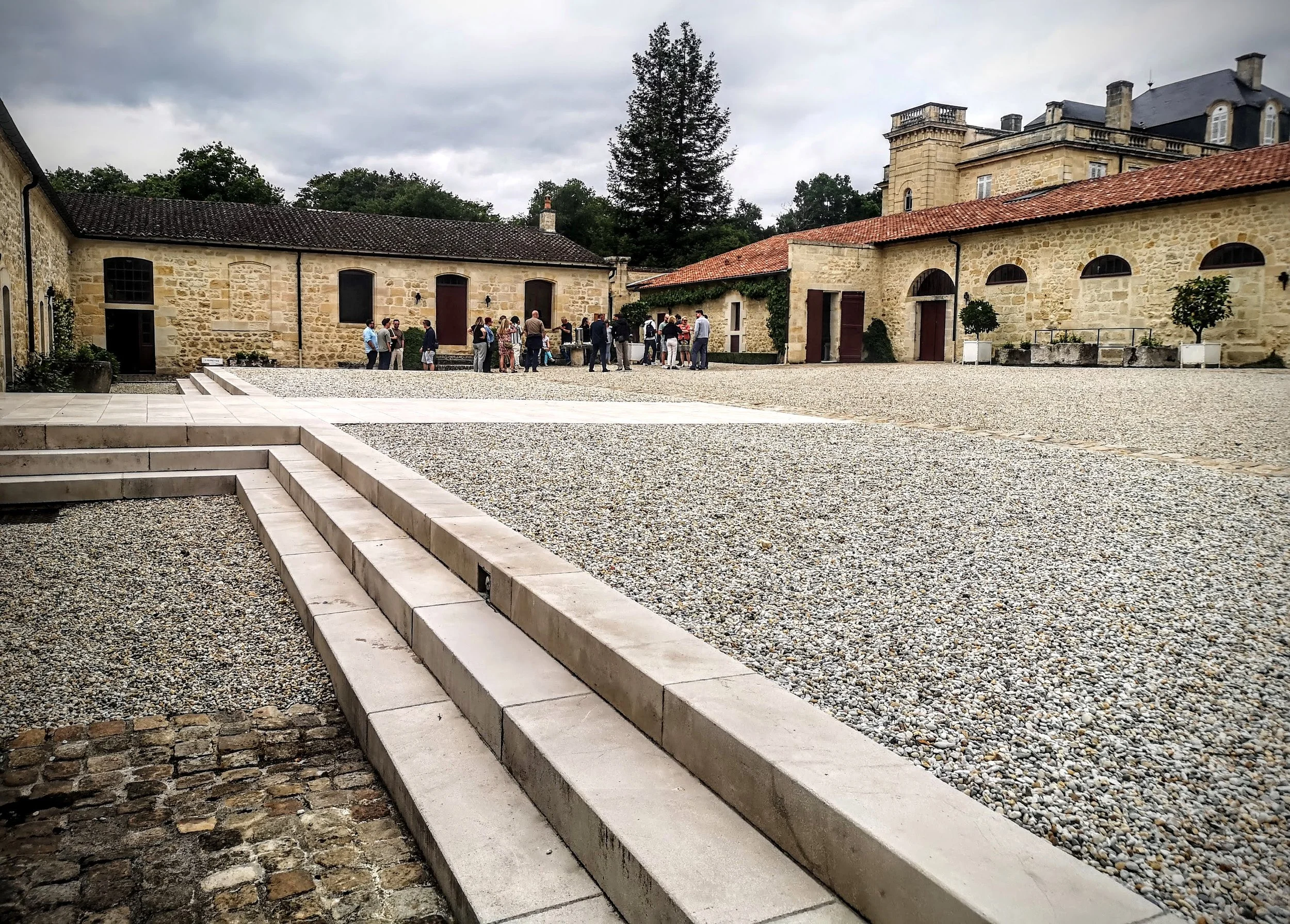
After the hors-d'œuvre on the terrace finished we adjourned to a cool dining room to continue lunch which was a relief from the June sun. When finished we enjoyed a swift coffee and cannelé in the courtyard of the stable complex.

