Michelin to Introduce a Guide to Wineries
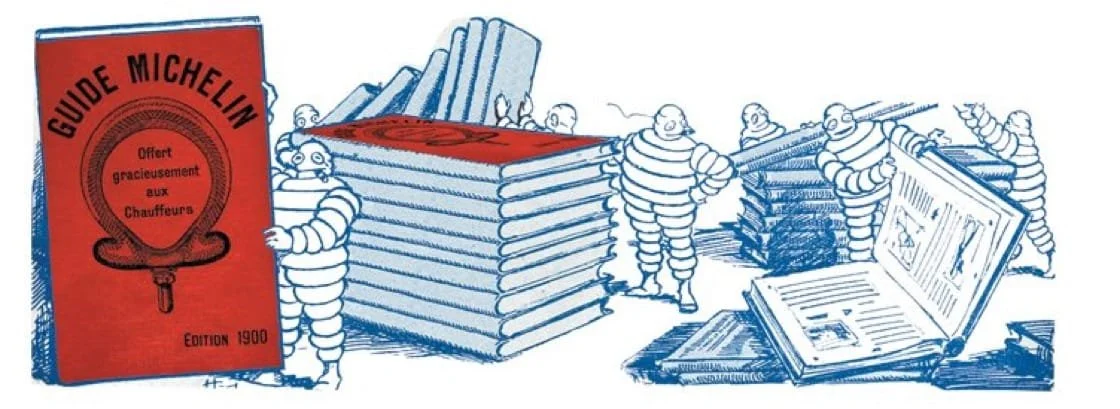
In 1900 Édouard and André Michelin first published their eponymous guide to boost the sales of their tyres. It started life with road maps, petrol stations and hotels, the reasoning being it would encourage people to drive more. Before long they added restaurants in what was to be seminal move, the popularity eventually making it the definitive and most influential culinary guide in the world. 125 years later the company has announced it will be expanding its guide to wineries. In a time when the wine sales are in decline can it be as influential or will it be drowned out in wine’s well established critical mass?
The Criteria and the Michelin 'Grapes’ Awards
The new guide will grade the wineries like they do restaurants, but instead of stars producers will get ‘grapes’ and will be judged by various experts described as ‘former sommeliers, seasoned critics and production experts”. To begin they will start with just two regions, Bordeaux and Burgundy, beginning next year. Michelin have released an outline of the criteria their awards are going to be based on. This from their website below:
Quality of Agronomy
Michelin Inspectors evaluate criteria such as soil vitality, vine balance and vineyard management, essential factors that directly influence wine quality.
Technical Mastery
The evaluation focuses on the technical execution of the wine-making process. Our inspectors are seeking precise and rigorous wine-making practices, producing wines that reflect the terroir and variety, without any distracting flaws.
Identity
The Guide will highlight winemakers who craft wines with a strong identity, expressing a sense of place, the winemaker’s personality and the culture behind
them.
Balance
Evaluation of the harmony between components such as acidity, tannins, oak, alcohol, and sweetness.
Consistency
Wineries will be evaluated across multiple vintages to ensure unwavering consistency in quality, even in the most challenging years. The Guide celebrates wines that reveal greater depth and excellence as time goes by.
The above is very much broad strokes, but noticeable by its absence is any mention of sustainability and environmental awareness. I would assume that is folded into ‘quality of agronomy’ as since 2020 Michelin have been awarding green stars to restaurants to ‘symbolism excellence in sustainable gastronomy’, and even give the restaurants a virtual pulpit on their website for the chefs to outline their vision. However with traditional vineyard sites in Europe and elsewhere facing existential threats bought by climate change I would like a more explicit mention of it. Vignerons are caretakers of the land and responsible plant husbandry should be a central tenet of any winemaker’s philosophy, and Michelin have a huge opportunity to champion this by placing it at the heart of their new guide.
Beyond this the other criteria feel a little overlapping: technical mastery highlights ‘rigorous winemaking’ that expresses both terroir and varietal typicité, while identity talks about winemakers that lend their wines a ‘sense of place’ and personality. Balance then talks about what are simply the components of a well-made wine.
Then we get consistency and how wineries will be ‘evaluated across multiple vintages’ which is of course how it should be, but I would really like to know the specifics of this: just how thorough will this be, how many vintages will they go back? Given they are starting with two regions that can produce wines of incredible longevity this feels like a crucial piece of information, especially when you read what the awards represent. Again from the Michelin website:
Three Grapes
Exceptional producers. Whatever the vintage, wine lovers can turn to the estate’s creations with complete confidence.
Two Grapes
Excellent producers who stand out as exceptional within their peer group and region for both quality and consistency.
One Grape
Very good producers who craft wines of character and style, especially in the best vintages.
Selected
Dependable producers who have been chosen for regular review, producing well-made wines that deliver a quality experience.
Immediately I read this with a degree of what, consternation, alarm even? “Whatever the vintage, wine lovers can turn to the estate’s creations with complete confidence”. It reminds me of a tasting with Marc Perrin a few years ago and his assertion that ‘there is no such thing as bad vintages, just different expressions of the winemaker’s art’, a belief clearly Michelin intends to put to the test. It was met it with collective raised eyebrows then, and I find myself raising them again to this.
Growing seasons are never consistent and always challenging, even for producers with the resources and expertise to deal with whatever Mother Nature can throw at them. From unseasonal frost, hail storms, heatwaves, drought, rot and these days increasingly wildfires, wines will be stylistically extremely diverse from one year to the next. Alcohol levels, tannins, fruit characteristics, acidity levels and texture all will have some degree of variation across vintages. Those extreme weather patterns can be extremely capricious and localised: one vineyard may lose its canopy to hail while its neighbour is untouched. Any farmer will tell you there are no guarantees when you are growing a crop.
However while to slow to change I will concede that French vignerons are fully embracing the modern science of winemaking and sustainable viticulture. Bordeaux in particular has transformed itself beyond almost all recognition over the last twenty years bought about by a combination of deep pockets and radically changing vineyard conditions.
Which circles us back to the question: just how far back is Michelin talking? Ten years, twenty years, thirty or more? Owners change, winemakers retire, fortunes of estates ebb and flow, climates shift and with them techniques and even the grape varieties will change. Before 2009 in Bordeaux great vintages came along two or three times a decade, in the 15 years since at least 8 are considered legendary and it is cooler, lesser years that have become the rarity. There are plenty of skeletons in the Bordelais’ closet from past vintages that they will not want tasted, but that equally are also no longer relevant to the current state of the winery.
It is for this reason we have and need vintage charts and critical scores, as well as brilliant sites like cellar tracker which can provide fantastically up-to-date tasting notes that take the guess work out of buying and opening older wines. To say you can buy any year ‘with complete confidence’ is a bold statement within the so-far open-ended criteria and is inherently problematic without tighter definitions. Michelin Stars can create expectations for recipient restaurants beyond what they can deliver, and sometimes beyond what they want to deliver. You can certainly predict situations where a customer has bought a 1972 Château Margaux buoyed by its 3 Grape rating only to be severely let down by what is considered to be one of the worst wines ever produced by the estate.
The Regions and their Potential Issues
It is no surprise that they are starting with Bordeaux and Burgundy, the usual suspects when it comes to French wine and Michelin being a French company. But while they are the most obvious regions for fine wine, evaluating them will be stepping into the proverbial lion’s den. They are already the two most thoroughly scrutinised wine regions in the world, each with respected and dedicated critics and both with existing classifications of quality and established hierachies, as well the biggest presence on wine’s secondary market
Burgundy’s current classification is done by climats , its hierachy defined by the quality of vineyard sites and their terroirs up to Grand Cru status. Domaines are generally small, family-owned affairs making what can be a multitude of wines from a wide patchwork of vine parcels from up and down the Côte d’Or, and often in achingly small amounts. Most will specialise within their particular village and from other villages nearby and express the nuances of those terroirs within a framework of a signature winemaking style.
Then you have the négociants operating in a parallel but divergent role, historically buying fruit, must or finished wine from smaller growers (which as a consequence of France’s Napoleonic inheritance laws there are thousands, some owning as a little as a single row of vines). They will vinify and blend these parcels to produce more generic, less terroir-specific wines in larger volumes under their own label, using the moniker ‘Maison’ as opposed to Domaine. Increasingly the distinctions between négociants and Domaines are being blurred as the former are buying more vineyards and making wines from them (called négociants-éleveurs or merchant-growers) threatening the Domaine’s status as the better, more expressive of the two. Navigating the contrast between them will prove difficult given that négociants will not always qualify for Michelin’s ‘quality of agronomy’ criteria given they do not always grow the grapes, but still will make outstanding wines.
Bordeaux’s classification is chaotic to say the least. The Médoc remains dominated by the archaic 1855 Classification (discussed here) whose static nature for over a century and a half means it is widely considered to be inaccurate, at best more of a guideline to the quality of wine an estate produces. Michelin’s classification has the potential to represent a genuine existential challenge to it, given the cultural capital and sheer gravitas the Guide will bring to the table. But it has stubbornly defied any attempt to change it throughout its 175 years of existence, will it be met with a simple Gallic shrug of indifference or even outright hostility?
Outside of that lies the troubled Cru Bourgeois designate, only now reaching some sort of equilibrium since the 2020 and 2025 revisions. There are some very worthy estates within it that may see the Guide as a way to shoulder their way onto the top table, although of more significance may be the well-respected but disillusioned estates that choose not to be classified by it, significant names like Sociando-Mallet and Gloria.
Going beyond the Médoc Graves has a cadre of famous, high-quality estates given cru classé status within the Pessac-Léognan AOC. St Émilion has four tiers up to Premier Grand Cru Classé A that is re-evaluated every 5 years, but like Cru Bourgeois some of the best estates have simply opted out. Pomerol has no classification at all but make some of the most expensive wines on the planet. Sauternes and Barsac provide an outlier with their famous sweet white wines, and then there are the workhorse regions of Entre-Deux-Mers and Côtes-de-Bordeaux regions.
Perhaps here the Michelin guide could provide a more pan-regional structure, but the suspicion is that they will not venture much beyond the main sub-regions given the quality of estates clustered within. Given that Bordeaux’s output rivals that of a small country I doubt they have the resources to go much further anyway, even if they desire.
The biggest challenge facing Michelin is the crowded market place they are stepping into (Indeed given they own The Wine Advocate they are already part of that market place). There are a plethora of heavyweight wine writers they are seeking to add their opinion to, names like Jancis Robinson, Allen Meadows, Neal Martin, James Suckling and Antonio Gallani, as well as publications like Decanter, Cocks & Féret and La Guide Hachette, and I feel like I am only scratching the surface. Every minutiae of every vintage is poured over, every major estate tasted and tasted again and given scores that are in turn poured over by consumers. On top of that every merchant will write their own vintage reports, and significant en primeur releases are followed immediately by a flurry of emails into their client inboxes with a selection of critic’s tasting notes and scores. This is the pre-existing machinery that gears up and rolls out every year, as well as a busy secondary market championed by trading platforms like Liv-Ex complimented by brokering services offered by most major wine merchants. This is the critical mass Michelin are stepping into.
Michelin’s point of difference is they will be evaluating an estate holistically rather than just the fruit of its labours. But will this approach bring some necessary surprises rather than a line up of the usual suspects: do we need the Michelin Guide to tell us again Pétrus and Domaine Romanee-Conti are world-class? I would love to see some unexpected names that will set the cat amongst the pigeons.
Conclusions
The wine industry operates within a feedback loop, a constant churn of information that circles through producers, critics, merchants and consumers. You want to buy a good steak you go to a butchers, you want to buy a good bottle of wine to go with it you might consult a vintage chart, look for tasting notes and critical scores, post on an internet message board or ask your merchant for recommendations. These days you might even use an AI sommelier (but please don’t). The same goes for when you are looking for a wine to lay down for the children, for investment or simply to be enjoyed for years to come. It is to that loop Michelin seeks to add its voice. How well can it work?
When the Guide was first conceived it was a means to sell more tyres. It was a combination of happenstance and timing that Michelin was able to seize the moment and become the global zeitgeist for culinary guides. If they can capture that lightning-in-a-bottle again with their wine guide remains to be seen. They certainly have the influence to do so: a Michelin Star can transform a restaurant’s fortunes, propelling it from local admiration to international fame and create a waiting list years long.
But fine wine has a well-established hierarchy forged through reputation based on merit, tradition and consistency, and this applies to both Bordeaux and Burgundy above all others. If anything these two venerable regions should be the last Michelin seek to codify in their own image, but at the same time it is inescapable that they must be the first. How it is received by the producers themselves may be key: the attentions of a Michelin star can bring burdens that some have found difficult to shoulder and more than one have been given back. Do top Châteaux need a Michelin ‘grape’, or will it be an essential arrow in the quiver when it comes to sales in an increasingly competitive global fine wine market?
I am a strong believer that the cream will rise to the top i.e. if a wine is good enough the market will react sooner or later. The best example of this would be the Super-Tuscans emerging from obscurity and defying the local regulations to become a unique fine wine category and commanding huge prices and slavish devotees. The market for top Burgundy and Bordeaux remains pre-eminent; the best estates within both regions already occupy enviable positions. Seeing where Michelin fits in with this mechanic is hard to envisage, likely it will certainly increase international demand, but I fervently hope arbitrary price hikes do not follow.
For lesser-known producers struggling for market share it will undoubtedly be a huge shot-in-the-arm, for estates like Lafite it would just be business as usual. And how will proud owners react if they do not get the award they want and believe they deserve: the most burning question is what will Mouton put on their label this time if they get second again?
Then there is the added pressure Michelin’s attention may bring, particularly the challenge of maintaining consistent quality across every vintage, regardless of what the growing season delivers. Put simply this requires deep pockets and a strong, talented, full-time vineyard team. There is a chance it will encourage conservatism over risk-taking, and may penalise growers who deliberately minimise human intervention and pursue a more natural approach to winemaking.
There is also increased pressure at the cellar door. Greater visibility is likely to drive higher levels of wine tourism and raise expectations around what a Châteaux or Domaine should offer visitors. While most estates operate visits by appointment, increased exposure may encourage entitled tourists to arrive uninvited and react negatively. Cellar-door restaurants are common in the New World, but although numbers are rising in Bordeaux and Burgundy, they remain the exception rather than the norm and require considerable investment from estate owners.
Time will tell the influence this move will have, and I for one am fascinated how Michelin will negotiate the potential pitfalls and excited for what will happen next. I hope the first thing they drop is the ‘grape’: it may be a little lost in translation but a 3-graped winery sounds off to my ear. I mean they give restaurants stars not saucepans, lets do the same for wineries.
Written by A James Cole