Bordeaux’s Left-Bank: The Wine of the Médoc
Part 1
When I started writing this it began as a regional profile of the Médoc but as it developed it organically pivoted to something different: a discussion of the merits of the 1855 Classification, the landmark ruling born of the whim of an Emperor that has since come to shape the fortunes of the region as a whole, and Bordeaux with it. Ever since then debate has raged over it with revisions both official and unofficial mooted, but ultimately every wave of change has broken on the rocks of stubborn resistance and political inertia, and today a century and a half later it still stands virtually identical to the day it was penned
The greater Bordeaux region is massive, boasting around 120,000 hectares under vine and a production that will often exceed 600million bottles in any given vintage, eclipsing the output of several countries. It is bisected by two rivers: the southerly Garonne rising from the foothills of the Pyrenees and the easterly Dordogne from its headwaters on the Auvergne mountains. They come together just west of Bordeaux town forming the mighty estuary of the Gironde.
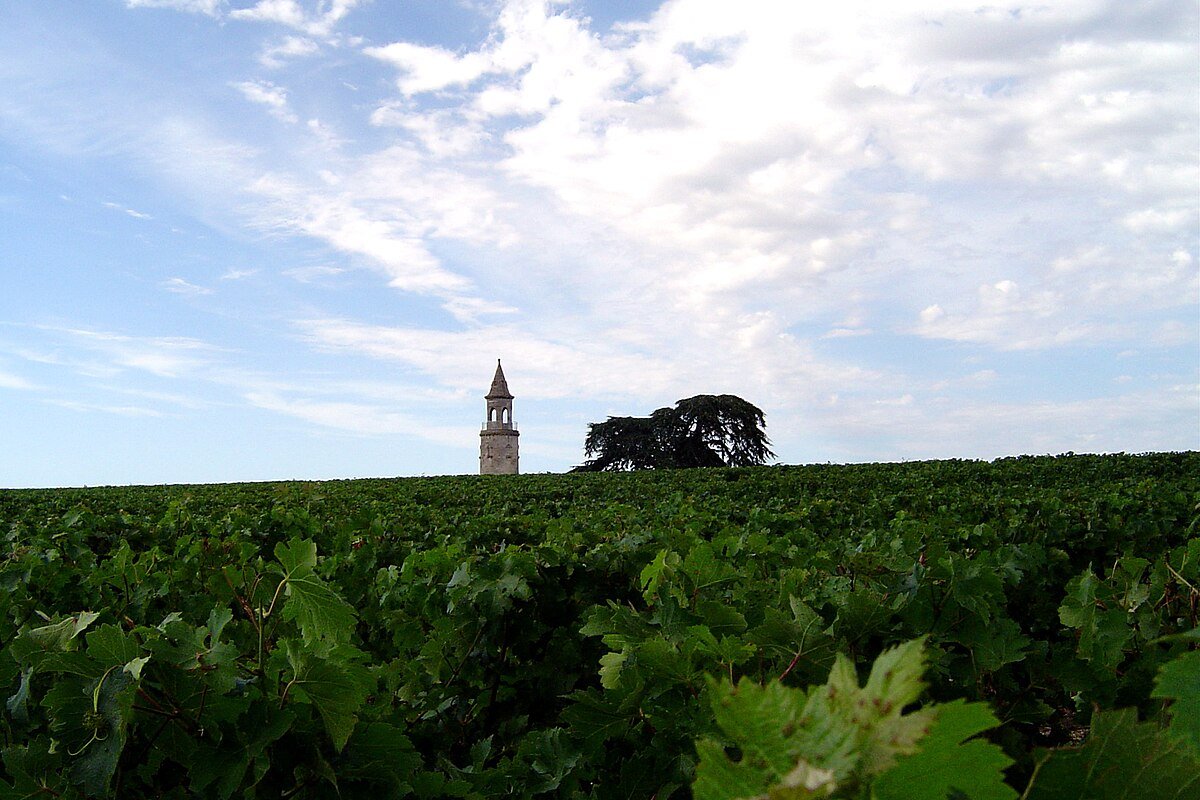
On its Atlantic side, sandwiched between the pine forests that run along the west coast and the estuary, lies the Médoc. It is an unassuming landscape: an 80km long strip of low-lying marshland reclaimed from the estuary in the 17th century. It forms a mosaic of gently undulating plateaux scored through by streams and shallow valleys. Here the grape is lord of all it surveys, a virtual sea of vineyards whose most remarkable feature are the Châteaux that rear up memorably into its skyline, each a hallowed cathedral to the vine.
It is these glittering Châteaux and their iconic wines that have become the poster child for the larger region as a whole, yet despite the attention Médoc demands year after year, it accounts for a mere 5% of the region’s overall production and its classed growths even less. Here I explore the reasons why: the anachronisms of its classification and how it has shaped its fortunes since, as well as its unique terroir, colourful history and traditions.
The Magic of Médoc
It is another region to the east the Bordelais call ‘Entre-Deux-Mers’ but to look at the map one wonders whether ‘Between-Two-Seas’ is a better fit for the Médoc. These bodies of water exert a huge influence over the area, with the proximity of the Atlantic creating a generous, temperate maritime climate while the region is protected from the ocean’s worst excesses by vast pine forests that dominate the land to the west. On the other side the Gironde estuary acts as a giant heatsink, moderating the temperature by absorbing warmth during the day and releasing it back at night. It also makes for higher humidity levels in the region, a boon when the dry conditions of their hot summers bite.
Vines have been planted here since Roman times but its modern epoch started when the marshes were drained by Dutch experts in the 17th century revealing its hidden treasure: a patchwork of free-draining gravel and limestone soils anchored by clay beds. These are the sort of liminal soils that force the vines to struggle, digging deep in search of water dramatically improving the quality of the fruit. Mild winters, moderate rainfall and long sunshine hours during the growing season, with addition heat spikes in the summer months combine to complete this ideal cauldron for nurturing the vines and their bounty, It is a magical terroir capable of producing some of the most profound and long-lived red wine in the world, something you might not guess looking at its unremarkable landscape
The Haut-Médoc sub-region constitutes the closest two-thirds of the region with its southern edge kissing Bordeaux town itself ending around 60k north-west, where the appellation switches to Médoc. Both regions are further divided by communes, smaller divisions delineated by variations in terroir that create subtle distinctions in style. These combine to form six distinct appellation-controlées: St. Estephe, Pauillac, St. Julien and Margaux that cling close to the banks of the Gironde, completed by Listrac-Médoc and Moulis-en-Médoc a bit further inland.
It is those famous first four that are home to the deepest, most rarified soils and characterful terroirs in the Médoc and in them you find the greatest concentration of cru-classé estates and some of the most famous Châteaux in the world, each of them anointed in perpetuity by that fateful judgement in 1855.
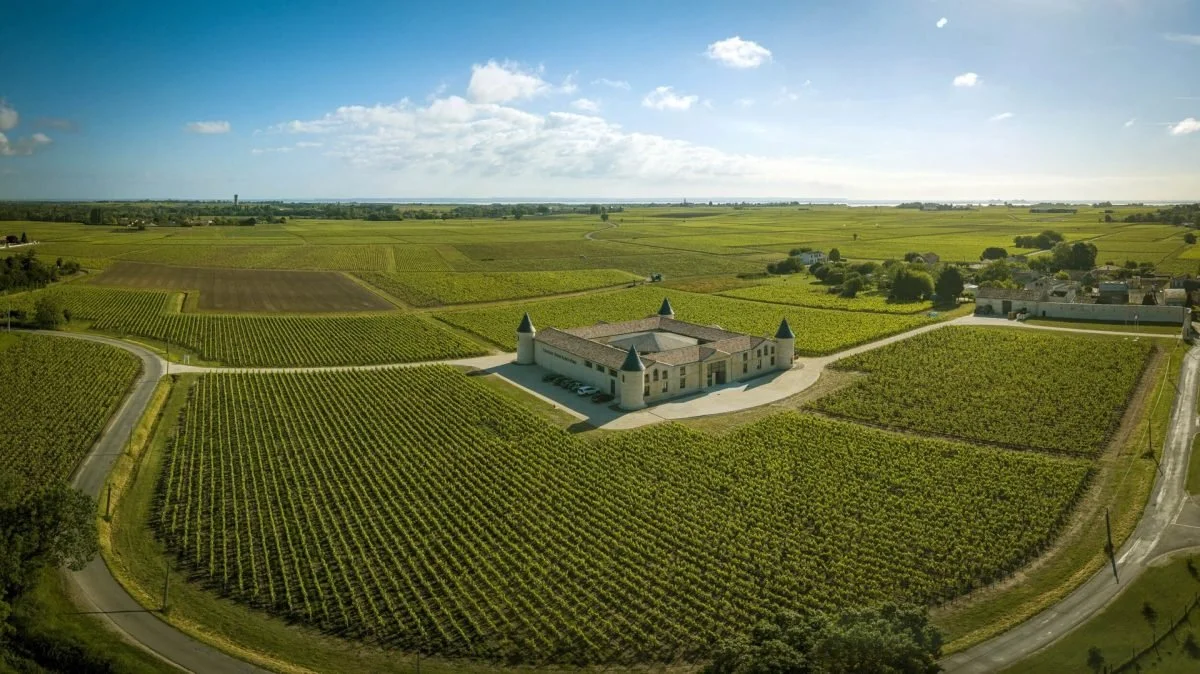
“Here the grape is lord of all it surveys, a virtual sea of vineyards whose most remarkable feature are the Châteaux that rear up memorably into its skyline, each a hallowed cathedral to the vine.”
And the fortune of the Médoc is irrevocably tied to those cru-classés and their origins in the 1855 Classification. Born of an era when France still had an Emperor, the classification remains in place almost exactly the same as the day it was first made official, despite the wine and winemaking having changed beyond almost all recognition. Back then there was little Cabernet Sauvignon planted and almost no Merlot with the principal grape being Malbec, now largely relegated to a bit-part in the blend. The wines were lighter in alcohol, colour and structure, little darker than a rosé and lacking the tannins of a modern claret, and élévage in barrel only practised by the richest Châteaux. These were not wines for the cellar, best drunk within the year, and often were blended with more robust, deeply coloured wines from further south.
The vineyards have changed too: at the time the classed-growths estates constituted around 2600 hectares of vines but that figure today is closer to 3600. The Châteaux now boast some of the most modern and sophisticated wine infrastructure and viticulture in the world, overcoming traditional inertia and fully embracing the modern science of winemaker and vine husbandry. Yet despite this historical flux the 1855 Classification remains utterly static (apart from a single notable promotion). It is an obdurate, archaic hierarchy that still casts a long shadow over the Médoc and by extension the rest of the modern wine world, but how and why?
The first place to start is to look at its origins, which are a little haphazard. The classification was not the idea of the Châteaux, or even the region’s Chamber of Commerce, but rather the instruction came from the Emperor himself, Napoleon III. To consolidate his recent political ascension he decided to emulate Britain’s World Fair held in the Crystal Palace a few years earlier and showcase France’s art and industry in a grand ‘Exposition Universelle de Paris’. As part of it he wanted the best wines from Bordeaux on display and tasked the Chamber of Commerce in producing a list. They immediately knew a hornet’s nest of proud and angry Châteaux-owners when they saw one and passed the buck along to the ‘Syndicat de Courtiers’, a collective of wine négociants and brokers, who were all too happy to take on the responsibility and produced the famous classification within two weeks.
Palais de l’Exposition Universelle (Palais de l’industrie), Champs-Elysées
The result was controversial at the time and has remained so throughout its entire existence. The list was heavily skewed towards the Médoc with all but one of the red wines granted Cru Classé status located in the region (Sauternes and Barsac, home to the great Botrytis-affected sweet whites, were also thoroughly classified, and will be covered seperately).
Haut-Brion was the lone exception. It historical importance was undeniable, almost certainly one of the first clarets ever imported to England, appearing in the cellar ledger of King Charles II in 1660 and mentioned in the diary of Samuel Pepys in 1663. It was also the first Bordeaux wine imported in the United States when Thomas Jefferson, then the US ambassador to France, sent back six cases in 1787. The fate of the rest of Graves is more opaque: at the time it was the older, better established region and commanded a lot of respect. There are suggestions the négociants who compiled the list were less familiar with the Graves producers, as their distribution went through a different network, which makes the cynic in me think the omission was intentional.
The right-bank was completely ignored. Pomerol was not yet established as producer of quality wine, and those of St. Émilion were considered inferior commanding lower prices on the market, despite the burgeoning reputation of Cheval-Blanc and Canon in particular. Again it is hard to escape the conclusion that regional bias and vested interest were likely significant factors in their exclusion.
But whatever the reasoning the result is beyond question: 57 estates comprised of 4 first growths, 15 seconds, 14 thirds, 10 fourths and 18 fifths. And there is has stayed ever since, but for a couple of exceptions: Château Cantemerle was added as a fifth growth in 1856 as an oversight, and famously after almost five decades of lobbying Mouton-Rothshild was promoted from second to first in 1973 (its classification had always rankled its ownership: its motto displayed on its label before 1973 was "Premier ne puis, second ne daigne, Mouton suis" which translates as "First, I cannot be; Second, I do not deign to be; Mouton I am". After its promotion this was changed to "Premier je suis, Second je fus, Mouton ne change" or "First, I am; Second, I used to be; Mouton does not change").
Barrels of 2nd Growth Château Léoville Barton waiting to be bottled
Beyond the regional bias the 1855 Classification was guilty of, the greater anachronism is the terms of the classification itself: the estate is awarded Cru Classé status, not its vineyards. This creates a significant dissonance to that most French of concepts, terroir, and is a sharp divergence to the hierarchical structure over in Burgundy where the opposite holds sway. There the vineyards and their specific micro-terroirs are awarded 1er and Grand Cru status no matter what domaine owns the vines.
To illustrate, while there were originally 58 estates classified there are now 62, but no new estates have been elevated (despite many worthy contenders) because several estates have been divided: Batailley became Château Batailley and Château Haut-Batailley, Pichon Longueville became Château Pichon Longueville Baron and Château Pichon Longueville Comtesse de Lalande and Boyd became Château Cantenac-Brown and Château Boyd-Cantenac.
Also consider the curious case of Château St. Pierre. The St. Julien estate first started producing wine in the late 17th century, and in 1767 it was acquired by Baron de Saint-Pierre, who lent it his name. Under his enthusiatic stewardship and generous investment the estate flourished and garnered a reputation for being one of the finest in the department. When the Baron died in 1832 the estate was inherited by his two children who did not share their father’s passion for wine. Despite their apparent disinterest in running a Château the estate was awarded 4th Growth status in 1855, and was considered the best of that tier at the time.
However decline followed quickly afterwards, as the children’s indolence led to the estate being broken up and by the 1920s only 2.5 hectares of the original remained. As fate would have it, some of those original vineyards had been purchased by Alfred Martin, father of Henri Martin a true Bordeaux legend and creator of Château Gloria. Henri (whose fascinating story I will tell another day) had a burning ambition to own a classed growth, and over the years he meticulously put back together St Pierre, culminating in the purchase of the original winery in 1982. Like a phoenix from the ashes St. Pierre spread its wings and flew again, a Quatrième Cru Classé once more (and its 2005 remains the profound red wine I have ever tasted).
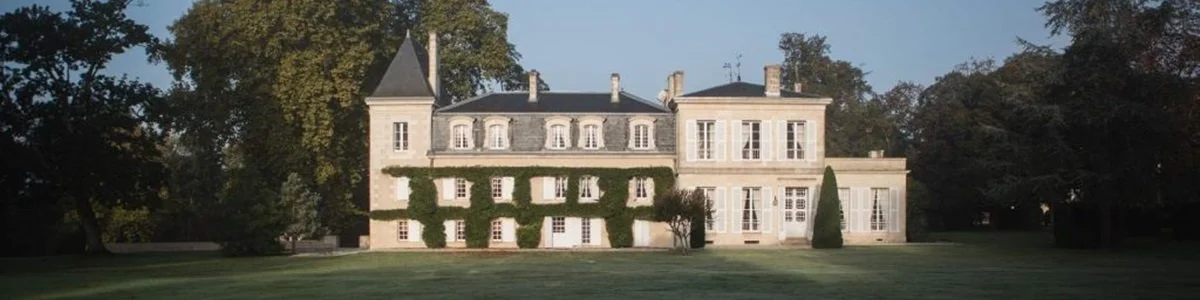
Phoenix-from-the-ashes 4th Growth Château St. Pierre in St. Julien
But logic dictates that an estate that for all intensive purposes has ceased to exist, and was like that for quite a significant amount of time, would lose its membership of what is wine’s most exclusive club. But if you can trace an estate’s lineage to an estate granted growth status in 1855 you can claim it for yourself, as Henri Martin amply demonstrated.
In contrast Henri’s other great labour of love, Château Gloria, was created by buying vineyards from various notable second-growth estates: Léoville-Poyferré, Gruaud-Larose, Léoville-Barton and Ducru-Beaucaillou, as well as third growth Château Lagrange and fourth growth Château Beychevelle. But despite the pedigree of it vineyards and the quality of its wine, Gloria can never enjoy classed growth status despite enjoying a similar reputation and equitable prices.
Equally any vineyard purchased by a property, as long as it is within the commune’s lieu-dit (and let’s be honest, sometimes beyond. I am looking at you Lafite), can be used by any of that commune’s Châteaux to make its wine, regardless of the vineyard’s terroir and overall quality. This creates a scenario where a previously unclassed vineyard can be bought by Latour or one of its peers and contribute to the Grand Vin of a first growth overnight. And while that sounds unlikely, bear in mind classed growths estates have collectively added 1000 hectares of vines since 1855 and those were not conjured out of the ether, rather purchased from unclassed estates.
So while the 1855 Classification remains static plenty of the Châteaux themselves have changed significantly, and in the modern day most are positively flourishing. There have been attempts to revise and update it: Bordeaux’s Chamber of Commerce made a concerted effort some hundred years after in 1961. It did not go well: after the new 3-tiered system was leaked to the press, with 17 Châteaux freshly de-classified and 13 set to be added, local uproar and regional political turmoil condemned it to a swift end. They have not tried it again.
There have also been multiple unoffical attempts. Robert Parker himself had a go in 1985, as well as Masters of Wine Clive Coates and David Peppecorn at seperate times. Liv-Ex, the fine wine trading platform, tried an updated version in 2009 which based the ranking on the prices the wines commanded in the secondary market much like the original classification. They have since been updating every two years and have included wines from other regions and countries producing a more international classification of fine wine rather than a Bordeaux-specific one. Of course price is never a true arbiter of quality in wine, rather more of the demand for a wine but it remains a useful exercise.
But none have left a mark on the classification itself, in the face of stubborn resistance from the Châteaux. You can see why they refuse all change; suddenly after a century and more you are trying to introduce promotion and relegation to a previously stable system. While plenty would no doubt welcome promotion, none will welcome relegation, with both the reputational and commercial hit that would entail. Hidebound traditionalists and risk-averse, many Châteaux (Mouton the notable exception) are content with their lot. Some, even Château Margaux itself, have seen their fortunes wane and the quality of wines plummet in the intervening years but their their classed growth status has been untouched. Others, with more dynamic and visionary owners and winemakers at the helm, have seen the quality of their wine dramatically improve. But while they cannot change their classification the market takes note and the higher demand for the wines are reflected in it: there are plenty disparities in price within the five tiers of cru-classés based on the reputations of the individual Châteaux.
To look at a more contemporary and fluid equivalent one might glance across the Gironde and at the travails facing St. Émilion and their classification as a comparison. The region introduced an official 4-tiered hierarchy in 1955 which is revised every ten years. But it has not been plain-sailing, particularly when the 2006 classification was challenged in court by demoted Châteaux citing flawed tasting and vested interests from those judging. It was declared invalid and instead the 1996 classification was continued to be used. Fine for those who had suffered demotion, terrible for those that had been promoted, with Xavier Pariente of Troplong-Mondot saying "That's almost 20 years of hard work and investment by all the personnel here wiped out at the stroke of a pen. It frightens me and it revolts me". Other estates, heavyweights like Cheval Blanc, Ausone, and Angélus have simply opted out of it while still commanding prices on a par with top Médoc estates, calling into question the necessity and validity of the classification.
The wine’s quiet slumber in Léoville Barton’s cave de fermentation
Then there is Pomerol: it is a much younger region and a relative late-comer as a producer of prestigious red Bordeaux, really developing in the later half of the twentieth century. But it has since become a powerhouse with the likes of Château Pétrus and Le Pin commanding astonishing prices. If re-classification happened today based purely on price like in 1855 the Châteaux of Pomerol would dominate the top ten. But Pomerol has no hierarchy at all amongst its estates, instead forging reputations based entirely on merit, and prices based on old-fashioned market forces, supply and demand.
And even within the rigid 1855 hierarchy there is unofficial mobility. Enter stage left new lexicons for the modern-day wines: ‘super-seconds’ and ‘flying fifths’. These are a loose group of classed growths that can and do challenge the pre-eminence of the firsts; second growths like Ducru-Beaucaillou, Léoville-Las-Cases, Pichon-Longueville Comtesse de Lalande, Montrose and Cos d’Estournel, and fifth growths like Lynch-Bages, Pontet-Canet and Grand-Puy-Lacoste. Then there are other estates like third growth Château Palmer and fourth growth Château Beychevelle who transcend their classification and command significantly higher prices than their peers. And beyond there is Graves and Pessac-Léognan, whose major estates like La Mission Haut-Brion, Domaine de Chevalier, Smith-Haut-Lafite, Pape-Clément and Haut-Bailly all enjoy good reputations and high demand, commanding similar prices to their Médoc counterparts despite being outside the classification.
These market forces are not dictated to by the classification, and Châteaux cannot afford to rely on their classed growth status to sell their wine. Today there is much stiffer competition for fine wines in what is now a global market: rival regions in France as well others in Europe like Piedmont, Tuscany, Rioja and Ribera del Duero. Then there are the ever-emerging challengers from the new world that are much more than just Bordeaux’s traditional rivalry with California. Consumers are spoiled for choice today, and to rest on your laurels is to be left behind.
In the past it is something you might have accused the Médoc of doing, but not today. The region’s vineyards remain largely unchanged with no significant expansion since 1855 and no need for a ‘classico’ zone. The soil is the same, and while modern times has seen average temperatures rise concomitant with climate change, the terroir still has the same magic. What has changed are the Châteaux themselves, and their ability to harness that magic. Cash-rich from recent outstanding vintages and incentivised by tax-breaks from the French government, many of the Médoc’s estates have renovated their wineries and adopted sustainable, organic and even biodynamic practises. The result is the Médoc now boasts some of the most modern and innovative wineries on the planet, and a focus on terroir that has fomented a viticultural and winemaking revolution that has rendered the region and wines practically unrecognisable from even as little as 20 years ago.
It is not to say the 1855 Classification has no influence anymore, but it is far from an absolute arbiter. That role falls to the consumer. Take for example second-growth Ducru-Beaucaillou: if it was promoted to first as it deserves would the market simply accept an arbitrary increase in price concomitant with its new status? Or if Lynch-Bages, who has so assiduously added to its vineyards over the years and makes some of the finest Pauillac outside of the first growths, was promoted to second growth would customer be prepared to pay more for it? Or has the quality of these wines already found their niche and price in the market and change may risk alienating a loyal customer base? Equally wines outside of the classed growths like Gloria, Sociando-Mallet and Potensac already command cru-classe prices, do they need promotion? And then you have the conumdrum of fitting in the various second wines in any re-ordering, given the prices and scores some do command.
Clearly the 1855 Classification is no longer accurate in both the quality of the wines nor the prices they reach, but at the same time it is not wholly irrelevant. It is Black Rod hammering on the closed door of the Commons to call Parliament to hear the King’s speech. It is Bordeaux’s grade 1 listed building and may not and should not be demolished, extended or altered in any way. The soils and climate create the terroir of the Médoc, but the 1855 Classification is the intangible soul of the region. With it they captured lightning in a bottle, propelling it to the forefront of fine wine all those years ago and sustaining it ever since, holding a fascination that can border on the tribal with customers.
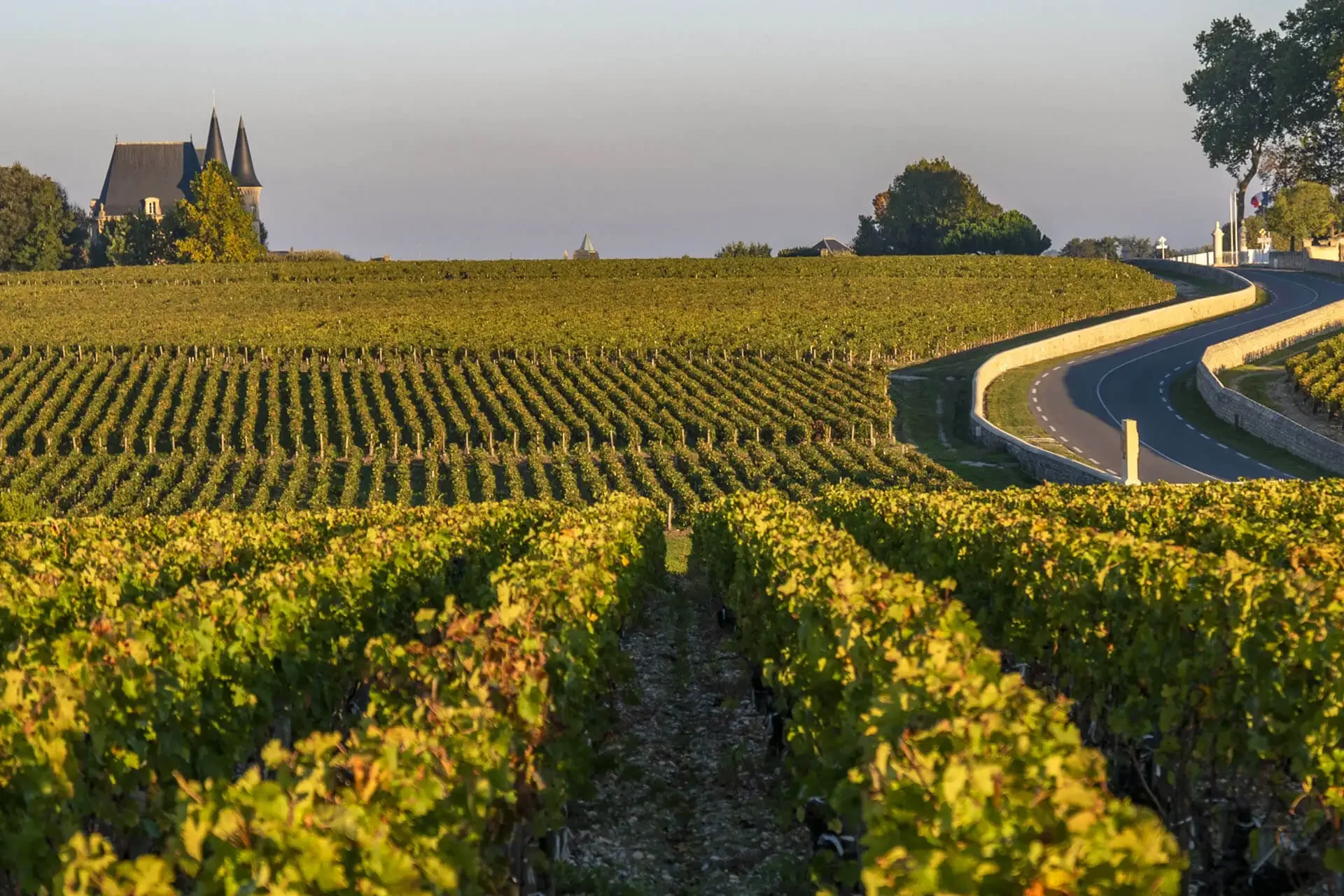
“It is Bordeaux’s grade 1 listed building and may not and should not be demolished, extended or altered in any way. The soils and climate create the terroir of the Médoc, but the 1855 Classification is the intangible soul of the region.”
It may not be perfect but St. Émilion’s attempts at their own hierachy illustrates how hard it is to create a classification that works for both the Châteaux and the consumer. Pomerol’s ascension points to a flexibility within the market that cannot and will not be controlled through the contrivence of classification anyway. The world is a much smaller place than it was in 1855, now all the information you need about a Château is only a google search away, with no négociant in sight.
It begs the question: does wine need hierarchies? In Burgundy the quality of the vineyard is judged but the talent of the winemaker is not, and with multiple ownership of 1er and Grand Cru vineyards the norm rather than the exception the style and quality of the wines produced from those terroirs can be significantly divergent. You see similar systems in Alsace with their Cru system, and in Germany where they identify top vineyard sites as Grosse Lage (Great Growth) and Erste Lage (First Growth). Barolo has a Menzioni Geografiche Aggiuntive system since 2010, which has 170 named vineyards as the best crus in the DOCG. These at least are evaluations of exceptional terroir and likely to result in profound wines.
Even Australia has a ranking albeit unofficial, the Langton Classification which judges the wines on their market values and is re-evaluated every 5 years, arguably the closest to the 1855 Classification. But plenty of other regions and countries have none. Beyond the Riserva system which is based on a wines ageing, there is a distinct lack of grading of producers in Spain’s great wine regions like Rioja. Super Tuscans rose to prominence and high prices while being labelled ‘Vino de Tavola’ (table wine). California’s boutique and achingly expensive producers have none, nor is there any in New Zealand, Argentina or Chile, all of whom have vignerons making fine wine that can stand shoulder to shoulder with any in the world.
So perhaps Pomerol provides the most compelling blueprint for fine wine: let the market be the ultimate judge rather than classification. And quite frankly it already is, driven by consumers who will actively seek out these wines just to experience their heady pleasures, and prices will adjust as supply and demand applies its agency over them. The danger is when pricing is more arbitrary, something the Médoc has been quilty of, and those prices creep beyond the pockets of true wine aficionados and turn the wine into something more performative, status symbols for the ultra rich and influencer wannabes, and less artisanal produce crafted of passion and precision for the palates of true wine lovers.
What does this say about the 1855 Classification? It is too late to close the barn door, the horse is over the hill and the one beyond and by now sired several foals. There is nothing that could change it for the positive in the modern setting, so let it remain as an anachronism of a past age and let us instead revel in its inaccuracies, quirks and contradictions. I say this as a merchant that has been selling it for 16 years: consumers do not just buy a wine just because it is a cru classé, they buy it because it is a great claret that they can enjoy for years to come, from a legendary vintage with high critical praise, and out of loyalty and personal tradition. The fact it is a classed growth is just icing on the cake.
Written by A James Cole